
language
Search Results:
Go Back
| Your Needs | JWEI Solutions |
| Is manual cutting inefficient and causing delays in delivery? | High Efficiency: The automated production line can quickly and accurately complete composite material cutting tasks, improving production efficiency. |
| Is manual cutting prone to errors with large size deviations, causing material waste and high costs? | High Precision: Advanced controls and cutting tech ensure dimensional accuracy ±0.2mm. |
| Need unattended operation for complex contour cutting? | Full Automation: *Integrated feeding-cutting-collection eliminates manual handling, reducing labor by 70%.* |
| Inconsistent edge quality (burrs/fraying) across diverse composites? | Universal Compatibility: Processes carbon/glass fibers, metal composites, etc. with laser-grade edges. |
The Seamless 3-Stage Automation Workflow
-
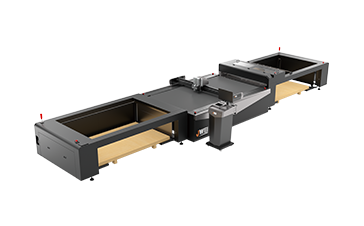
Stage 01: Synchronized Heavy-Duty Roll Loading & Feeding The workflow initiates with a specialized material handling sequence designed for heavy, sticky, or delicate composite rolls (such as carbon fiber prepregs, dry glass fiber mats, and technical textiles). Utilizing an automated, tension-controlled unwinding cradle paired with an intelligent heavy-duty feeding gantry, the system advances the composite media smoothly onto the conveyor bed. This configuration completely eliminates material stretching, weave distortion, or cross-layer slippage during entry, ensuring that un-cured fibers remain perfectly relaxed and dimensionally stable.
-
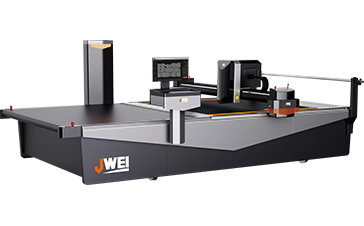
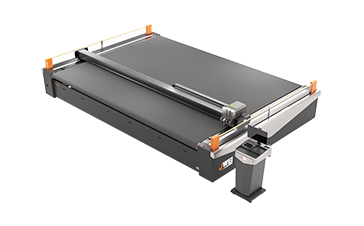
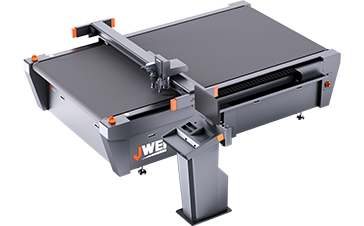
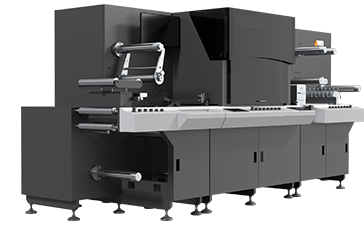
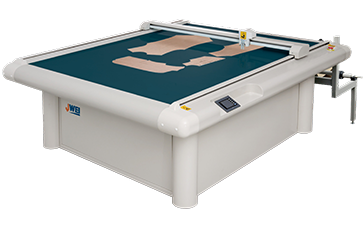
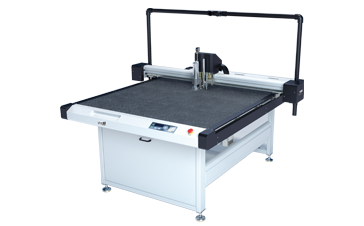
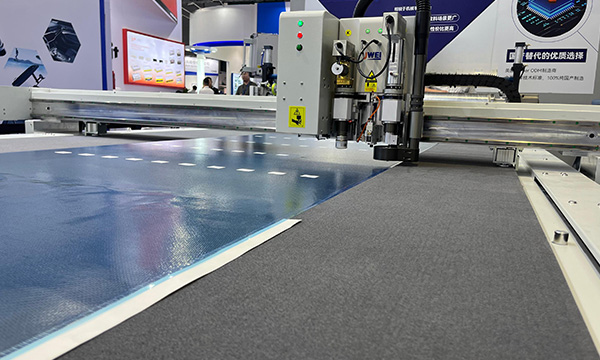
Stage 02: Continuous Die-Less Precision Processing The core of the automated manufacturing line relies on our heavy-duty automated composite materials cutting & conveyor system architecture, built on a robust automatic flat bed die cutting machine framework. Driven directly by computerized CAD engineering profiles, it cuts complex multi-shape kits continuously without requiring physical wood-and-steel molds or setup overhead. During execution, high-pressure zone-controlled vacuum chambers lock down the media through an airtight sacrificial film, while heavy-duty tools execute micro-level contour trimming, interior window punching, and high-velocity parts nesting with zero fiber fraying or resin accumulation.
-
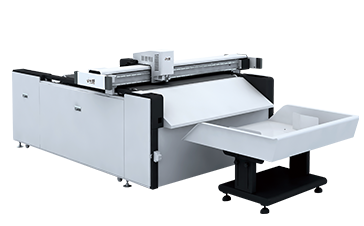
Stage 03: Automated Extraction & Kit Sorting Upon completion of the high-speed tool path, the synchronized conveyor matrix advances the processed composite layout forward to the extraction zone. An integrated robotic pick-and-place arm or an automated collector gantry systematically lifts the finished composite blanks and neatly groups them by ply kit ID or assembly layer onto the unloading pallet. Simultaneously, the backing paper and dry scrap matrix are guided away into a dedicated waste collection system, minimizing manual post-press sorting and creating a lean, clean-room-ready manufacturing pipeline.
Technical Matrix: Modular Tooling & Integration
1. Modular Tooling & Substrate Compatibility
| Tool Module | Cutting Technology | Target Materials & Substrates |
| Pneumatic Oscillating Tool | Ultra-powerful, high-amplitude vertical blade oscillation for dense media. | Heavy-duty carbon fiber prepreg, thick woven glass fibers, aramid sheets (Kevlar), and multi-layer technical textiles. |
| Driven Rotary Knife Tool | High-speed motorized decagonal rotary blade for friction-free rolling shear. | Thin glass fiber surface mats, dry carbon weaves, non-woven technical fabrics, and PE/PVC backing foils. |
| Heavy-Duty Routing Spindle | High-velocity rotary spindle milling for rigid sandwich configurations. | Cured resin-matrix composite plates, rigid engineering thermosets, and thick structural honeycomb core panels. |
2. Digital Pre-Press & Integration Architecture
| Integration Layer | Supported Protocol / Workflow | Operational Benefit |
| Seamless Industrial CAD Link | Direct vector rendering for .DXF, .PLT, .IGS, .STEP formats. | Bypasses file conversion overhead; accepts structural composite nesting files directly from major engineering systems and PLM platforms. |
| Algorithmic Yield Optimizer | Real-time automated nesting and synchronized tool-path generation. | Maximizes expensive carbon/glass fiber material utilization, reducing scrap matrix waste and optimizing factory throughput with zero manual intervention. |