
language
Search Results:
Go Back
| Your Needs | JWEI Solutions |
| Laser cutting causes burnt edges and yellowing, failing to meet the cutting requirements of high-demand customers. | Specially made tungsten steel blades... provide burr-free cutting, wide material compatibility, and a service life supporting continuous operation for 70 hours. |
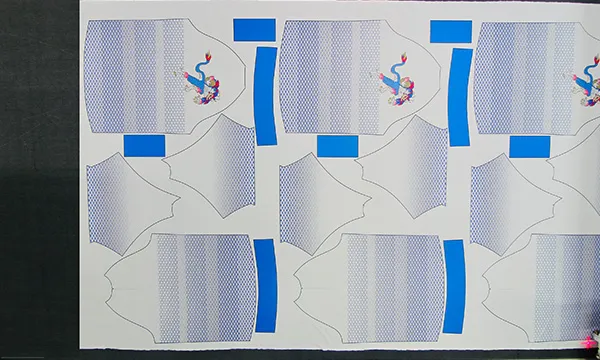
| Demanding blade-cutting speeds matching lasers | Maximum cutting speed is 1.5 meters per second, and cutting a single digitally printed sportswear piece takes less than one minute. |
| Digital printing is mostly done on rolls of material, emphasizing high cutting efficiency and placing great importance on continuous feeding. | Independently developed multiple feeding racks to accommodate different users’ material types and efficiency requirements. |
The Seamless 3-Stage Automation Workflow
-
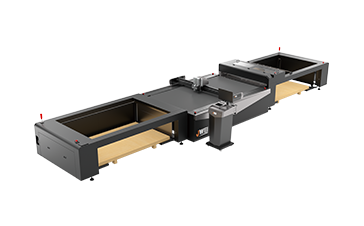
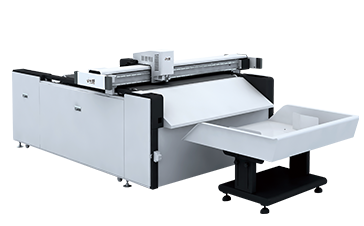
Stage 01: Adaptive Sheet & Roll Material Feeding The workflow initiates with an intelligent material handling sequence engineered to support diverse digital print streams. For rigid graphic substrates (such as PVC foam boards, KT boards, and composite plates), the system utilizes a high-volume pneumatic suction matrix to ensure continuous single-sheet separation and entry. For flexible roll media (such as adhesive vinyl, canvas, or banner textiles), a synchronized, tension-free feeding mechanism advances the printed graphics smoothly onto the cutting zone without skewing or wrinkling.
-
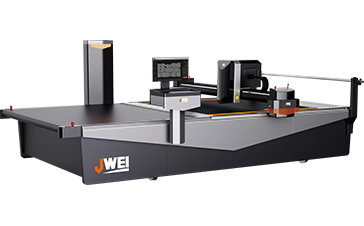
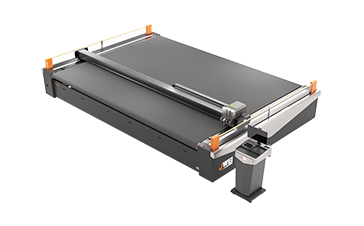
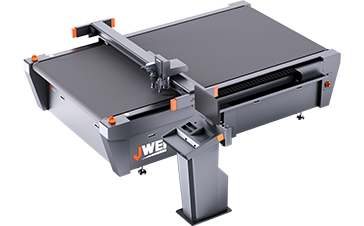
Stage 02: High-Speed Precision Contour Processing The heart of the post-press line relies on our advanced digital print-to-cut & automated finishing solution architecture, built on an ultra-stable automatic flat bed die cutting machine framework. Driven directly by digital pre-press vector workflows, it entirely eliminates the high costs and lead times of traditional steel dies. During execution, an advanced high-precision CCD vision registration camera automatically scans printed registration marks on the fly, instantly calculating and compensating for any material shrinkage, stretch, or print distortion to deliver flawless contour cutting, kiss-cutting, and creasing alignment.
-
Stage 03: Synchronized Extraction & Neat Stacking Upon completion of the high-speed digital tool path, the synchronized heavy-duty conveyor bed moves the die-cut graphics forward to the downstream extraction zone. An automated collection gantry systematically lifts and neatly stacks finished boards or sheets onto the unloading pallet, while the surrounding waste matrix is managed and cleared away efficiently. This eliminates manual sorting bottlenecks, protects delicate printed surfaces from scratching, and maintains a lean manufacturing pipeline ready for direct shipping or assembly.
Technical Matrix: Modular Tooling & Integration
1. Modular Tooling & Substrate Compatibility
| Tool Module | Cutting Technology | Target Materials & Substrates |
| High-Frequency Oscillating Tool | Rapid vertical blade oscillation for clean structural shearing. | Corrugated cardboard display stands, honeycomb boards, thick greyboards, and KT foam cores. |
| Heavy-Duty Routing Spindle | High-speed rotary spindle milling for rigid graphic sheets. | Rigid acrylic signage, aluminum composite panels (ACP), dibond, and thick architectural plastics. |
| Kiss-Cut & Drag Knife Tools | Dual-pressure adjustable tools for linear tracing and half-cutting. | Self-adhesive vinyl stickers, vehicle wraps, polypropylene films, and thin custom labels. |
2. Digital Pre-Press & Integration Architecture
|